Ginger, nausea, and why a sedating pill should not be the first move
Ginger and P6 acupressure have human evidence. Dimenhydrinate has a long label of fog. For ordinary motion and morning queasiness, start with the options that leave you awake.

Nausea is not a character flaw and it is not a vitamin deficiency. It is a protective reflex with too many triggers: a winding road, a first trimester, a smell, a migraine, a stomach bug, an anesthetic. The American default is still a little pink pill that makes the world go dim. That pill has a job. It should not be the opening move for ordinary queasiness.
This guide is about the non-drug stack that has actual human data (ginger, P6 wrist pressure, a few boring behavioral tricks) and about why dimenhydrinate is a blunt instrument. It also points to two products we reviewed and like: the patch at motionpatch.com and the bands at p6health.com. Those pieces are product coverage. We sell reviews. A link is not a Best of rank.
What you are actually treating
Motion sickness is a sensory argument. The inner ear reports movement. The eyes, if you are reading a phone in the back seat, report a still page. The brainstem treats the mismatch as possible poison. Pregnancy nausea is a different chemistry, with a worse morning and a better long-run safety constraint. Postoperative and chemotherapy nausea are clinical, and this article is not a substitute for the protocol your oncology or anesthesia team already wrote.
The useful split is mild, predictable nausea you can plan for (the school run, the ferry, the first twelve weeks) versus nausea that arrives with warning signs. Blood in vomit, a sudden severe headache, chest pain, confusion, inability to keep water down, or a child who is limp is not a ginger-tea problem.
Ginger: the plant that earned the page
Ginger (Zingiber officinale) is not a vibe. The rhizome contains gingerols and shogaols that act on the gut more than on the cortex. That is the point. You are trying to settle the stomach, not anesthetize the driver.
The cleanest file is pregnancy. Systematic reviews of randomized trials have found ginger better than placebo for nausea scores in early pregnancy, with a safety record that obstetric groups have been willing to mention as a non-drug option. Typical studied amounts cluster around 250 mg, taken a few times a day, or about 1 gram of dried ginger across a day. Fresh tea is harder to dose. A candy that is mostly sugar is a candy.
Postoperative nausea has a smaller, still encouraging meta-analysis trail. Motion sickness is messier: some trials help, some do not, and a capsule is not the same as a scent. Chemotherapy adjunct data exist and are not a reason to skip the antiemetics your oncologist prescribed.
What ginger is not: a cure for food poisoning, a reason to ignore gallbladder pain, or a blood-thinner loophole. High supplemental doses can interact with anticoagulants. Food amounts in cooking are not the same conversation.
If you want a capsule, look for a labeled ginger extract and a dose in the range the trials used. If you want a travel product that does not ask a child to swallow a pill, that is where a well-made patch and a P6 band earn a bag hook.
P6 is a location, not a lifestyle brand
The P6 (Neiguan) point sits on the inner forearm, about three finger-widths above the wrist crease, between the two prominent tendons. Pressure there has been studied for postoperative nausea and for pregnancy queasiness. Cochrane-level reviews of wrist stimulation are not a standing ovation, but they are not a shrug either. Some people get a clear reduction. Some get nothing. Almost nobody gets drowsy.
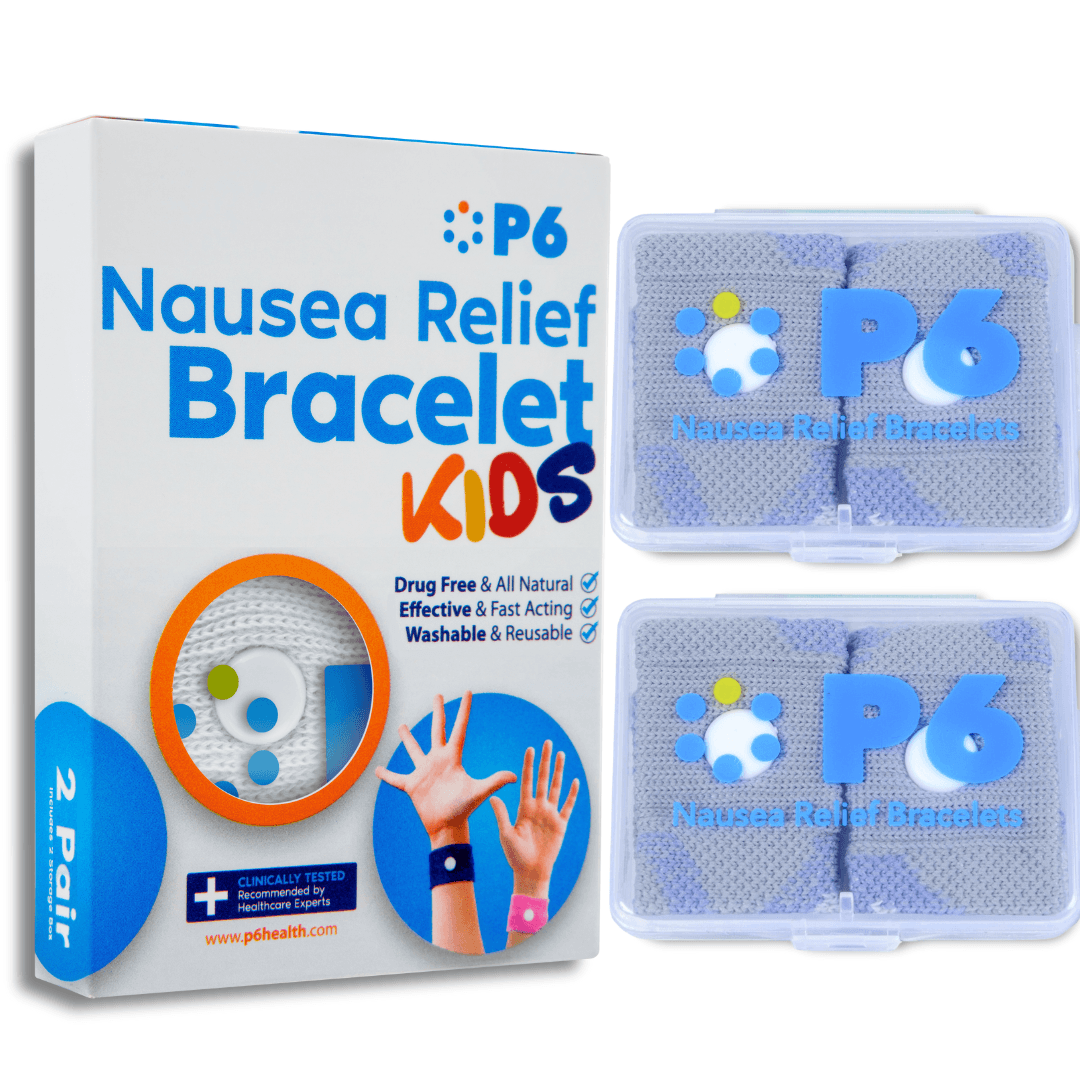
A band only works if it actually presses that point. A loose fashion bracelet is jewelry. A child-size band on a child-size wrist is the difference between “we tried acupressure” and “we wore a souvenir.” Our review of P6 Health is about a band that is built for that job.
Why dimenhydrinate should not be the first move
People type “diphenhydrinate.” They mean dimenhydrinate, the OTC motion-sickness antihistamine sold as Dramamine and a pile of store brands. Chemically it is diphenhydramine (the Benadryl molecule) bolted to a mild stimulant. The net clinical effect is still an anticholinergic sedative.
That is why it “works.” It turns down vestibular signaling and it turns down you. The label is not subtle: drowsiness, dry mouth, blurred vision, thickened mucus, and, in older adults, confusion and a higher fall risk. It is a poor match for anyone who has to drive, sit an exam, watch a toddler, or keep a blood-pressure appointment. It is a worse match for older adults already on other anticholinergic drugs.
Parents know the pattern. A ten-minute car ride becomes a tablet that lasts the afternoon. The child is no longer nauseated. The child is also no longer present. For short, predictable trips, a drug-free patch or a P6 band is the more proportionate tool.
Dimenhydrinate is not evil, and this is not an instruction to stop a medicine a clinician chose for severe seasickness or a vestibular disorder. It is a ranking of defaults. A drug that buys comfort with fog should lose to options that do not charge that tax, unless those options have already failed.
Scopolamine patches are a different, prescription-strength story with their own anticholinergic load. Do not confuse a ginger or herbal travel patch with a prescription disc behind the ear.
The boring extras that still work
- Look at the horizon. Do not read in the back seat.
- Cool air on the face beats recirculated heat.
- A small, dry snack beats an empty acidic stomach for many travelers. A grease-heavy breakfast does not.
- Alcohol and nausea are not a clever mix.
- Peppermint is a reasonable adjunct for some stomach upset. It is not ginger’s equal in trial volume.
What we reviewed
We wrote two product pieces and we recommend both as first-line, drug-free kit items:
- Motion Patch, sold at www.motionpatch.com: an all-natural, drug-free nausea patch the brand rates for up to 12 hours. This is the product we would put in a glove box.
- P6 Original nausea bands from www.p6health.com: wrist bands aimed at the P6 point, including child sizing. This is the product we would put on a kid who gets sick on the school run.
They are related brands. A patch and a band are not rivals. One is a timed application. The other is reusable pressure. Using both on a long travel day is not stacking drugs.
When natural is not enough
Hyperemesis gravidarum, chemotherapy emesis, inner-ear disease, and bowel obstruction are above this article’s pay grade. So is a first episode of vomiting blood. If ginger and P6 do not touch a new, severe pattern, the next step is a clinician, not a stronger internet herb.
Nutritionist Guide is not your clinician. Do not stop a prescribed antiemetic from this page. Pregnancy, children, and anyone on blood thinners should check a specific product and dose with the person who already knows their chart.
Bibliography
Sources and references
Citations below are representative of the evidence types we consult. They are drafted as examples for this preview site and should not be treated as a complete or verified bibliography.
- 01Viljoen E, et al. A systematic review and meta-analysis of the effect and safety of ginger in the treatment of pregnancy-associated nausea and vomiting. Nutr J. (Example citation.)
- 02Committee on Clinical Practice Guidelines–Obstetrics. Nausea and vomiting of pregnancy. ACOG. (Example citation; ginger is discussed as a nonpharmacologic option.)
- 03Lee A, Chan SK, Fan LT. Stimulation of the wrist acupuncture point PC6 for preventing postoperative nausea and vomiting. Cochrane Database Syst Rev. (Example citation.)
- 04Matthews A, et al. Interventions for nausea and vomiting in early pregnancy. Cochrane Database Syst Rev. (Example citation.)
- 05U.S. National Library of Medicine. Dimenhydrinate: MedlinePlus Drug Information. (Example citation; sedation and anticholinergic effects.)
- 06Chaiyakunapruk N, et al. The efficacy of ginger for the prevention of postoperative nausea and vomiting: a meta-analysis. Am J Obstet Gynecol. (Example citation.)