Creatine loading vs 5 g a day: do you need the loading week?
Loading is optional. Hultman 1996 showed about 20 g a day for six days and about 3 g a day for 28 days produced a similar rise in muscle total creatine. Antonio and the 2021 ISSN misconceptions review say you do not have to load. For most people, we recommend 5 g of monohydrate a day.
The loading week is a ritual with a paper trail. It is also optional.
If you want creatine, the molecule that has the file is creatine monohydrate. Harris, Söderlund, and Hultman showed in 1992 that swallowing it raises the creatine sitting in muscle. Hultman and colleagues showed in 1996 that you can get there fast with a high-dose week or more slowly with a few grams a day. Antonio and a 2021 ISSN review team said the quiet part out loud: you do not have to load.
For most people who have a reason to take creatine, we recommend 5 g of monohydrate a day. Load only if you truly need stores up in under a week. We are not inventing a third protocol, a “88% more absorbed” caption, or a Best of rank.
How we evaluated this
This is a protocol question, not a new trial. We are reading three papers that already did the work, plus the ISSN 2017 position stand this desk already uses for the ordinary daily range.
We did not:
- Biopsy anyone.
- Re-run Hultman in a Lemon Lime pouch.
- Treat a checkout caption as a saturation curve.
- Turn “loading works” into “loading is required.”
We did keep the numbers inside the papers. About 20% is Hultman’s comparison, as Antonio restates it. It is a muscle-creatine rise, not a strength percentage and not a fat-loss claim.
The format argument is already filed. Creatine gummies are Poor as a delivery system. This page does not reopen HPLC. It refuses to use that candy as a 20 g loading vehicle.
What a “loading week” actually is
Classic loading, as later reviews describe the Harris and Hultman era, is about 20 g a day for five to seven days, usually split into four 5 g servings. Some protocols write 20 to 25 g, or 0.3 g per kilogram for that same short stretch. Then a maintenance dose of about 3 to 5 g a day.
That is a lot of powder in a small number of days. It is not a different creatine. It is the same crystal, bunched up.
Harris 1992 is the elevation paper, not the loading-versus-daily paper. Seventeen subjects took 5 g of monohydrate four or six times a day for two or more days. Quadriceps total creatine rose. The rise was largest in people who started lower. In some, Harris reported an increase as much as 50%. One hour of hard one-legged exercise raised stores more in the worked leg than in the resting one. A 5 g dose also raised plasma creatine in a way that 1 g did not. None of that is a gummy finding. None of it is a named stick trial.
Hultman 1996: same neighborhood, two calendars
Hultman, Söderlund, Timmons, Cederblad, and Greenhaff published “Muscle creatine loading in men” in the Journal of Applied Physiology in 1996 (PMID 8828669). The comparison this desk keeps repeating is the one Antonio’s 2021 review quotes from that paper:
| Protocol | Calendar | Muscle total creatine |
|---|---|---|
| About 20 g a day | 6 days | Similar rise, about 20% |
| About 3 g a day | 28 days | Similar rise, about 20% |
That is the whole trick. The high-dose week fills the tank sooner. The low daily dose gets to a similar fill if you give it about a month. Hultman is not a finding that 20 g is “more effective creatine.” It is a finding about time.
We are not attaching a strength percentage, a VO2 claim, or a body-recomposition number to that table. Those would be other papers, and they would still not make loading mandatory.
Antonio 2021: loading is not required
Antonio, Candow, Forbes, Gualano, Jagim, Kreider, Rawson, Smith-Ryan, VanDusseldorp, Willoughby, and Ziegenfuss answered a list of creatine myths in JISSN in 2021 (s12970-021-00412-w). Question 8 is the one on this page: is a loading phase required?
Their answer: no. Lower daily doses of 3 to 5 g raise intramuscular creatine. They take longer to reach the top of the tank. The review’s working recommendation is about 3 to 5 g a day for a minimum of four weeks if you want saturation in the same neighborhood as a load. Choose the load only when the calendar is actually short.
The same review is honest about the cost of rushing:
- A loading week often adds 1 to 3 kg of body mass, mostly water, in the first days.
- Single servings above about 10 g are the ones they flag for gastrointestinal distress. Split the 20 g if you insist on loading.
Those are review statements, not a new lab certificate from this desk. They are why we score a time-sensitive loading week Fair: it works, and it asks you to drink more GI risk and more early scale weight for a head start you will not keep if you then quit.
The ISSN 2017 position stand still treats 3 to 5 g a day as the ordinary range and loading as an optional faster protocol. That is the same fork. It is not a third invention.

Who might still load
Load if a real date sits inside seven days and creatine stores are the thing you are trying to move: a meet, a short camp, a study protocol that starts next Monday. Then split the 20 g, drink water, and plan on the scale moving. After that week, you still need the daily 3 to 5 g or the tank drains back.
Do not load because a tub said “must load,” a coach inherited 1996 as a commandment, or a video promised that skipping the week “wastes” the bottle. Hultman already ran the patient version.
Do not load if you have known kidney disease, a clinician-directed fluid or sodium limit, or you were told to avoid creatine. A bigger first week does not make a contraindication smaller.
Vegetarians and people with lower baseline stores sometimes show larger rises when they start. Harris noted that pattern. It is a reason they may notice creatine, not a reason they owe the aisle a 20 g week.
Do not load with gummies
If 5 g of labeled creatine in a wet, acidic gummy is already a reliability problem, 20 g in candy is not a protocol. We rate creatine gummies Poor as a loading vehicle because we already rate them Poor as a daily vehicle. The chemistry is in the gummies guide. This page will not launder a loading calendar onto a format that cannot be trusted at one serving.
Dry crystalline monohydrate, mixed and drunk, is the object Harris and Hultman actually used. A dry stick of that same crystal is the same object until you add water. Mix it and finish it. Do not park a loaded bottle for days.
A daily 5 g habit, including a labeled stick
Five grams a day is the top of the ordinary 3 to 5 g range. It is one scoop most tubs already print. It is also one Rephora Labs stick.
Sister-brand label. Rephora Labs is owned by OCN LLC, the same company that publishes Nutritionist Guide. This is not an outside pick. The outbound link goes to the brand. Hultman and Antonio are powder papers. They are not Rephora-product trials.
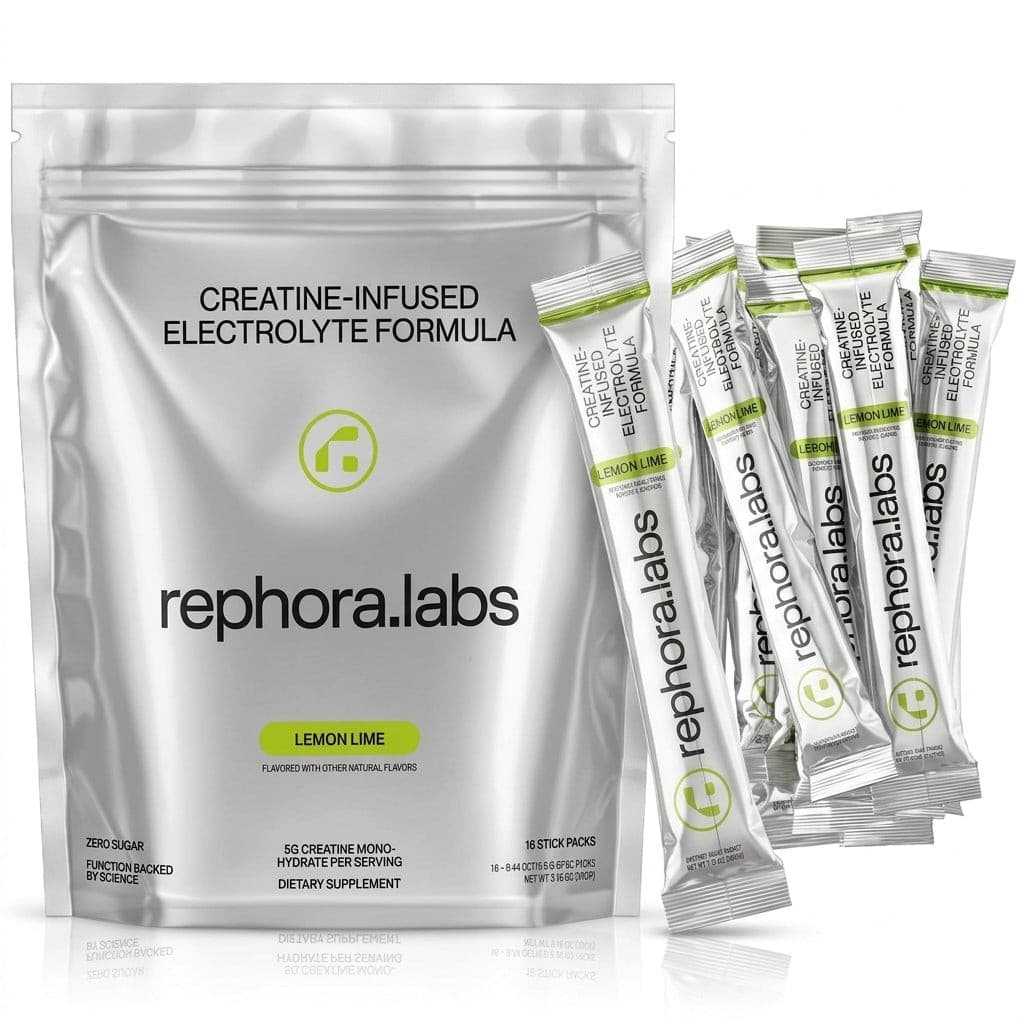
The brand’s own framing matches the daily side of this page: 5 g micronized monohydrate, no loading phase required, mix in 16 oz (20 oz is milder; do not use 12 oz). We repeat that as a brand fact that agrees with Antonio, not as a clinical study of IonGate or of a Lemon Lime pouch.
The full product argument is the Rephora Labs review. The salt-versus-sports-drink file is electrolytes, sports-drink hype, and the creatine habit. Shop the stick, if you want the sister brand, at rephoralabs.com.
If you never want a sister brand named, a third-party-tested tub of creatine monohydrate and a glass of water do the same job. The physiology does not require our logo. The electrolytes habit guide is the place we say when the salt in that stick actually earns its keep.
Scores, said in one place
Daily 3 to 5 g monohydrate for most people: Excellent. That is the Hultman slow arm plus Antonio’s “not required.” Five grams a day is the number we tell a reader who is going to remember one scoop.
Classic loading week when the clock is actually short: Fair. It works. It costs more GI risk and more early water weight. It is a calendar tool, not a loyalty test.
Creatine gummies as a loading vehicle: Poor. Wrong format, worse at a loading dose.
None of that is a Best of rank. Best of is not launched. A sister-brand 5 g stick is an example of the daily habit, not a trophy for loading.
The short version
Harris: oral monohydrate raises muscle creatine. Hultman: about 20 g a day for six days and about 3 g a day for 28 days land in a similar ~20% neighborhood. Antonio 2021: you do not have to load; 3 to 5 g a day for at least four weeks is enough for comparable saturation.
Take 5 g a day. Load only if next week is the actual deadline. Do not load with gummies. Mix a dry powder or a dry stick and drink it. If the stick is Rephora, mix it in 16 oz and remember it is owned by the same company that publishes this page.
Nutritionist Guide is not your clinician. Do not start creatine if you have known kidney disease or a clinician has told you to avoid it. A loading week is not a work-around for that sentence. This page is not a race-week dose table and not an assay of any pouch.
Bibliography
Sources and references
Linked citations go to the publisher, PubMed, PMC, or the news report. Marketplace assays are industry testing, not randomized trials.
- 01Hultman E, Söderlund K, Timmons JA, Cederblad G, Greenhaff PL. Muscle creatine loading in men. J Appl Physiol. 1996;81(1):232-237. PMID 8828669. About 20 g/day for 6 days versus about 3 g/day for 28 days produced a similar ~20% rise in muscle total creatine. Powder work in men, not a named-product trial. PubMed
- 02Harris RC, Söderlund K, Hultman E. Elevation of creatine in resting and exercised muscle of normal subjects by creatine supplementation. Clin Sci (Lond). 1992;83(3):367-374. PMID 1327657. The elevation paper: 5 g monohydrate, four or six times a day for two or more days, raised quadriceps total creatine in 17 subjects. Oral creatine is absorbed. Not a gummy study and not a stick trial. PubMed
- 03Antonio J, Candow DG, Forbes SC, et al. Common questions and misconceptions about creatine supplementation: what does the scientific evidence really show? J Int Soc Sports Nutr. 2021;18:13. https://doi.org/10.1186/s12970-021-00412-w. Loading is not required. About 3–5 g/day for a minimum of 4 weeks reaches comparable muscle saturation. The review restates Hultman’s ~20% comparison and notes more early water weight and possible GI distress with large single servings during a load. Full text
- 04Kreider RB, Kalman DS, Antonio J, et al. International Society of Sports Nutrition position stand: safety and efficacy of creatine supplementation in exercise, sport, and medicine. J Int Soc Sports Nutr. 2017;14:18. Ordinary daily range of 3–5 g, with loading as an optional faster protocol. Not a product trial. PMC5469049
- 05Rephora Labs. Product facts at rephoralabs.com: 5 g micronized creatine monohydrate per stick; mix in 16 oz (20 oz milder, not 12 oz); brand says no loading phase is required for that 5 g/day habit. Manufacturer claims, not an independent assay and not a Hultman replication.