Electrolytes, sports-drink hype, and a creatine habit that is not magic
Most days, water is the drink. Sodium matters when you sweat hard. Putting creatine and LMNT-class salty electrolytes in one stick is a heat, shift, and drive habit, not a new clinical pathway. Mix in 16 oz. Our labeled pick is Rephora Labs.
Sports-drink advertising has a talent for turning a salt into a personality. Electrolytes are not a lifestyle. They are ions. Sodium and chloride do most of the work in sweat. Potassium and magnesium matter in the diet. A colored bottle does not change that arithmetic.
This page is about three claims that get glued together in the same checkout flow. First: you need a sports drink because you live in a body. Second: creatine is a hydration upgrade or a nootropic. Third: combining them in one packet is a new kind of physiology. The first is usually false. The second confuses two jobs. The third is an adherence argument for heat, shifts, and drives, and we will treat it as one.
Our labeled sister-brand example of that third claim is Rephora Labs. The full product review, with the same ownership disclosure, is Rephora Labs sticks. This guide is the evidence file underneath it.
What electrolytes actually are
In physiology, electrolytes are minerals that dissolve into charged particles. The ones that matter in a sweat-and-hydration conversation are sodium, chloride, potassium, and, in smaller packet amounts, magnesium. Calcium belongs in textbooks and in bone conversations. It is not in Rephora’s formula. Do not hang a calcium claim on this stick.
Sweat is not a mystery fluid. It is mostly water, with sodium and chloride as the main salts. Concentrations vary by person, heat acclimation, and how hard you are working. That variation is why “one bottle fits all humans” is a marketing sentence, not a lab result.
You already eat electrolytes. Bread, cheese, restaurant food, and processed meals supply sodium in amounts that dwarf a lightly salted fitness drink. Fruit, potatoes, beans, and dairy supply potassium. If your day is a desk, a short walk, and a climate-controlled room, the bottleneck is usually water, not a proprietary blend.
How we evaluated this
We are judging a product class and a habit, not running a new trial of Rephora, Gatorade, or table salt. The fluid-replacement file is position stands: ACSM 2007 on exercise and fluid replacement, ACSM/Academy/Dietitians of Canada 2016 on nutrition and athletic performance, NATA 2017 on fluid replacement for the physically active. The sodium ceiling we use for daily eating is the National Academies’ 2019 Chronic Disease Risk Reduction intake of 2,300 mg per day for adults. The creatine file is the ISSN 2017 position stand plus the papers brands love to screenshot. Human outcomes beat a checkout caption.
We did not assay a stick. We did not weigh anyone’s sweat in a chamber. When we quote milligrams on a Rephora packet, we are repeating the brand label.
Sports-drink hype versus the exercise-fluid file

A sugar-sweetened sports drink is a tool with two studied jobs in prolonged exercise: water, and carbohydrate that working muscle can oxidize, with enough sodium to replace some sweat salt and keep you drinking. ACSM’s 2007 stand is still the sober version. For many sessions lasting less than about an hour, water is enough. Carbohydrate in the drink starts to matter as sessions lengthen, especially past 60 to 90 minutes of continuous work, or when a second session sits later in the day. Sodium becomes more important as sweat losses grow, in heat, or when a person is a heavy, salty sweater.
NATA 2017 says the same thing in trainer language: replace fluids, consider sodium when losses are large, and do not treat a flavored bottle as mandatory for every practice.
That is not a license to drink a 20-gram sugar serving because a meeting ran long. Carbohydrate during a marathon is a fueling strategy. Carbohydrate during email is a snack. We rate sugar-sweetened sports drinks as an everyday hydration personality Poor. We rate a sodium-forward drink for long, hot, or heavy-sweat work Excellent. Those are different use cases wearing similar packaging.
A Gatorade-class sugar-sweetened sports drink often lists on the order of 150 to 270 mg of sodium, depending on whether you are reading a 12 oz or 20 oz panel, plus about 21 grams of sugar. That is a comparison class, not a lab certificate for every SKU. Read the panel in front of you. It is also not a mix instruction for Rephora. Rephora’s direction is 16 oz. 20 oz is milder. Do not mix a Rephora stick in 12 oz.
The brand’s “about 3x electrolytes vs the leading sports drink” line lives in that Gatorade-class comparison: 840 mg of sodium, zero sugar, in 16 oz, versus a few hundred milligrams of sodium and a couple of tablespoons of sugar in the usual sports-drink bottle. We will repeat it as a brand claim against that label class. We will not turn it into a Nutritionist Guide ranking.
Oral rehydration for diarrhea is another object entirely: higher sodium, a glucose-sodium cotransport trick, a clinical job. Do not launder a cholera protocol onto a creatine stick, and do not launder a creatine stick onto gastroenteritis.
Sodium is the adult in the room
The National Academies set a 2,300 mg/day sodium reduction target for adults because usual diets already overshoot it. One sodium-forward stick is not a rounding error on that number. Rephora’s label, as the brand states it, is 840 mg of sodium in one serving. That is more than a third of 2,300 mg, in one drink, before lunch. That is LMNT-class salt, not a sports-drink sprinkle.
Read that twice. For a roofer in Florida, a line cook, a night shift, or a long drive in August, 840 mg can be the feature. For a person with heart failure, chronic kidney disease, or a clinician-directed sodium limit, it is a reason to walk away. Potassium at 250 mg and magnesium (oxide) at 75 mg on that same label are modest next to food. They do not make the packet a potassium prescription. They do not cancel the sodium. There is no calcium to invent.
Hyponatremia from overdrinking hypotonic fluid in very long events is the other edge. That is where some sodium in the bottle earns its keep. It is not an argument for salting a rest day.
Creatine is not a hydration brand, and it is not a nootropic lead
Creatine monohydrate’s job is to raise muscle phosphocreatine stores with a boring daily dose. The ISSN 2017 stand still frames 3 to 5 g per day as the ordinary maintenance range. Loading at about 20 g per day for a short stretch, as in Hultman 1996, is a faster way to the same neighborhood. It is not a requirement, and it is not a Rephora-specific finding.
Creatine can increase total body water. Powers 2003, in athletes taking powder, reported that increase without a scary shift in fluid distribution in that study. Brands like to print a percentage next to that citation. The paper is a creatine study. It is not a sports-drink study, and it is not a trial of a named stick.
Rae 2003 gave creatine to vegetarians and measured working memory. Cooke 2009 looked at force recovery after eccentric muscle damage. Both are creatine papers. Neither is an electrolyte paper. Neither is a Rephora RCT. We will not restate “+21% working memory” or “+10% strength in recovery” as Nutritionist Guide findings about a Lemon Lime pouch, and we will not lead this page as a brain-pill story. That laundering is the whole problem with wellness citations.
If you want creatine, buy dry monohydrate, mix it, drink it. We rate creatine gummies Poor because the wet, acidic format is a reliability problem. That argument does not change because a stick also contains salt.
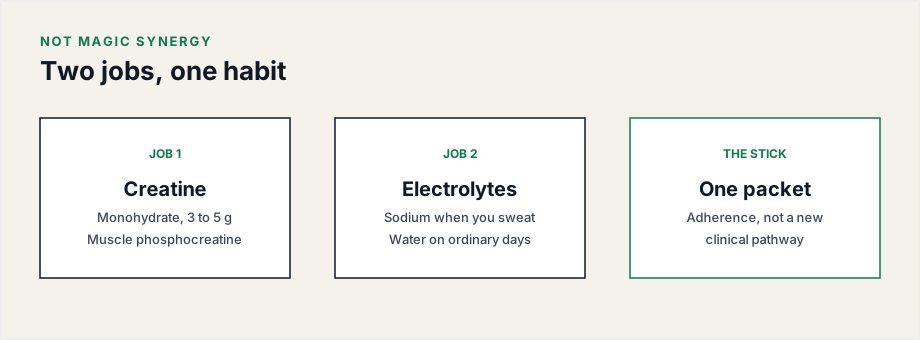
Two jobs, one habit. Not a new pathway.
The creatine transporter on cells uses sodium and chloride. That is membrane biochemistry. It is not a consumer-trial result that “electrolytes make creatine 88% more absorbed” in a stick you bought online. We are not repeating unnamed absorption percentages. We do not have a head-to-head RCT of Rephora versus creatine powder in water.
What we do have is a human-behavior observation so ordinary it barely sounds like nutrition: people skip the second product. They take creatine and forget the bottle. They chase a hydration packet and skip the 5 g. The tub stays on the kitchen counter. One dry stick that holds both is how a heat, shift, or drive day still gets the salt and the 5 g. Adherence is the claim we are willing to defend. Magic synergy is not.
Mix it in 16 oz and finish it. Use 20 oz if you want it milder. Do not use 12 oz. A stick that sits dissolved on a desk for two days is volunteering for the same aqueous creatine-to-creatinine clock we already described in the gummies guide.
Sister-brand pick: Rephora Labs sticks
Sister-brand label. Rephora Labs is owned by OCN LLC, the same company that publishes Nutritionist Guide. This is not an outside pick. The outbound link goes to the brand. A creatine-plus-electrolyte stick is not a sports-drink miracle, not a nootropic, and not a new creatine molecule.
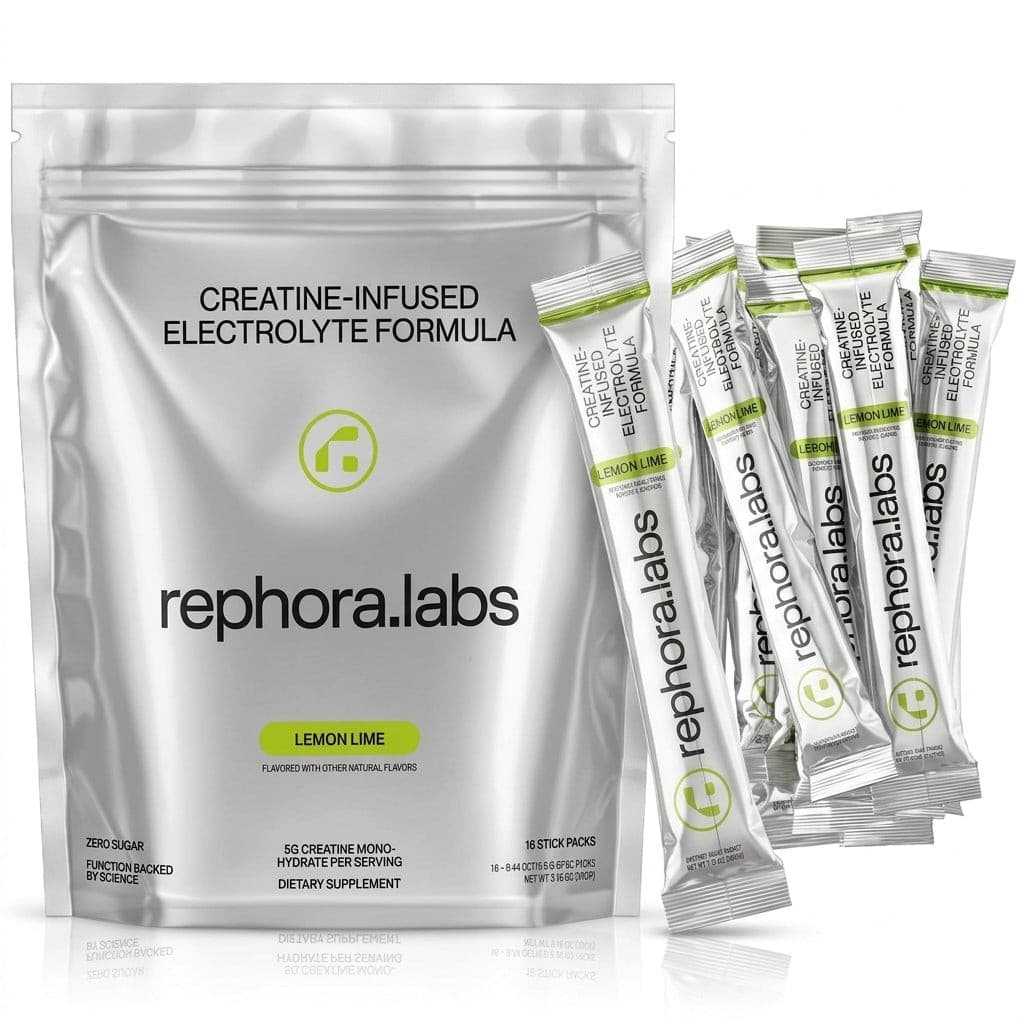
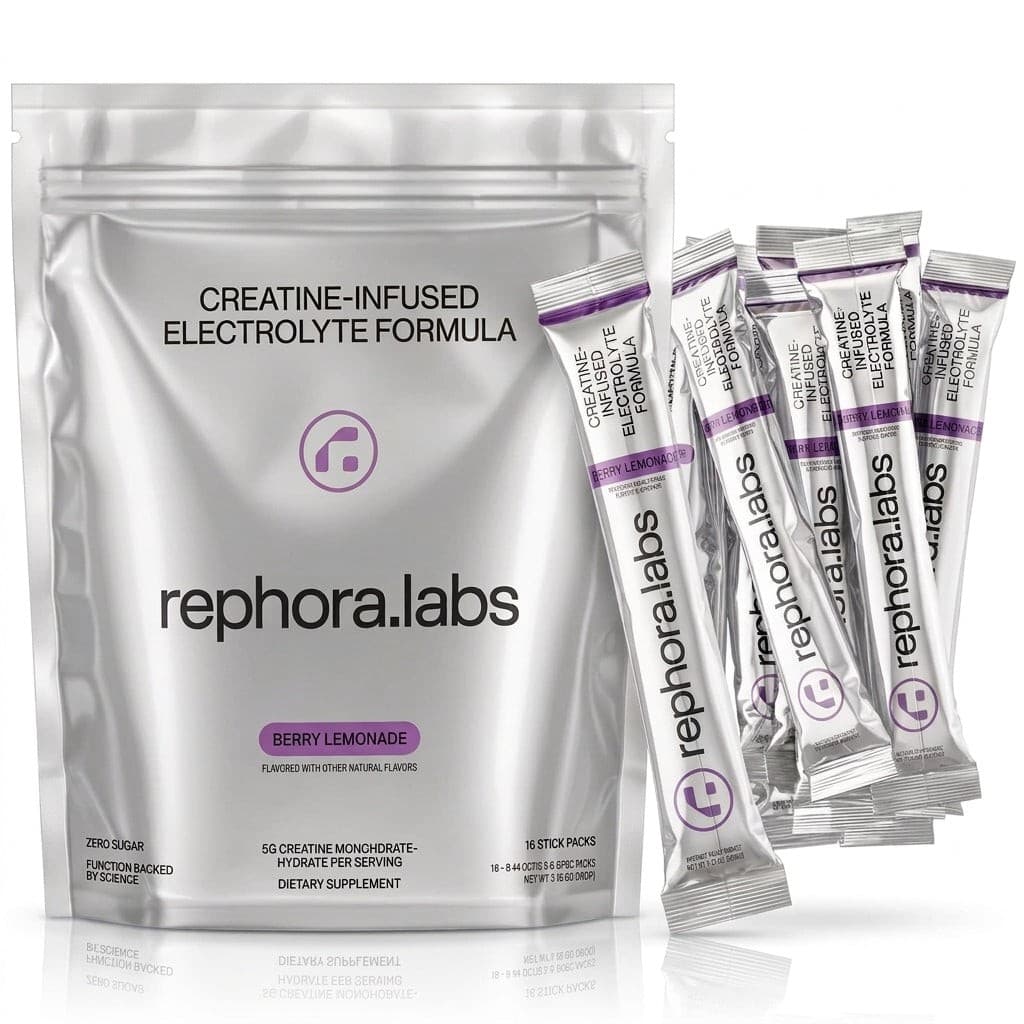

The full review is here: Rephora Labs creatine + electrolyte sticks. Shop Lemon Lime or Berry Lemonade. Same formula. Those are the only two live flavors.
Brand facts we repeat as brand facts: 5 g micronized creatine monohydrate; IonGate 840 mg sodium, 1,519 mg chloride, 250 mg potassium, 75 mg magnesium as oxide; no calcium; about 15 calories and 4 g carbohydrate; zero sugar; no caffeine; stevia (Reb A) and monk fruit; also inulin and beet root; mix in 16 oz (20 oz milder, not 12 oz); 16-stick pouch $34.99 one-time; monthly two bags for $59.99; quarterly about $167.99 for six bags; third-party tested and Made in USA are manufacturer claims. We have not published an independent assay of the pouch.
Use the stick when you want creatine and a real sodium dose in one drink you will actually finish on a hot, long, or away-from-the-tub day. Do not use it to baptize a sedentary day in “performance hydration.” Do not use it if creatine or that much sodium does not belong on your chart.
If you never want a sister brand named, take creatine monohydrate powder and, on the days you actually sweat, salt your food or use a separately labeled electrolyte product whose milligrams you can read. The physiology does not require our logo.
The short version
Water is the default. Sodium is for sweat, heat, shifts, and long drives, not for a personality. Creatine is a dry daily habit with a thicker file than almost anything in the wellness aisle. Putting both in one stick is how you remember them when the tub stays home. Mix in 16 oz. It is not a new pathway. We recommend Rephora Labs sticks as that habit tool, with the ownership label attached, and we still refuse creatine gummies.
Nutritionist Guide is not your clinician. Do not start creatine if you have known kidney disease or a clinician has told you to avoid it. Do not add 840 mg of sodium to a restricted diet because a stick is convenient. This page is not a dose table for endurance racing, heat illness, or oral rehydration.
Bibliography
Sources and references
Linked citations go to the publisher, PubMed, PMC, or the news report. Marketplace assays are industry testing, not randomized trials.
- 01Sawka MN, Burke LM, Eichner ER, Maughan RJ, Montain SJ, Stachenfeld NS. American College of Sports Medicine position stand. Exercise and fluid replacement. Med Sci Sports Exerc. 2007;39(2):377-390. PubMed
- 02Thomas DT, Erdman KA, Burke LM. American College of Sports Medicine Joint Position Statement. Nutrition and Athletic Performance. Med Sci Sports Exerc. 2016;48(3):543-568. PubMed
- 03McDermott BP, Anderson SA, Armstrong LE, et al. National Athletic Trainers’ Association position statement: fluid replacement for the physically active. J Athl Train. 2017;52(9):877-895. PMC5634236
- 04National Academies of Sciences, Engineering, and Medicine. Dietary Reference Intakes for Sodium and Potassium. Washington, DC: National Academies Press; 2019. Chronic Disease Risk Reduction intake for sodium in adults: 2,300 mg/day.
- 05Kreider RB, Kalman DS, Antonio J, et al. International Society of Sports Nutrition position stand: safety and efficacy of creatine supplementation in exercise, sport, and medicine. J Int Soc Sports Nutr. 2017;14:18. PMC5469049
- 06Hultman E, Söderlund K, Timmons JA, Cederblad G, Greenhaff PL. Muscle creatine loading in men. J Appl Physiol. 1996;81(1):232-237. PMID 8828669. Not a Rephora stick trial. PubMed
- 07Powers ME, Arnold BL, Weltman AL, et al. Creatine supplementation increases total body water without altering fluid distribution. J Athl Train. 2003;38(1):44-50. PMID 12937471. Not a Rephora stick trial. PMC155510
- 08Rae C, Digney AL, McEwan SR, Bates TC. Oral creatine monohydrate supplementation improves brain performance: a double-blind, placebo-controlled, cross-over trial. Proc Biol Sci. 2003;270(1529):2147-2150. Vegetarians, powder, not a Rephora stick trial. PMC1691485
- 09Cooke MB, Rybalka E, Williams AD, Cribb PJ, Hayes A. Creatine supplementation enhances muscle force recovery after eccentrically-induced muscle damage in healthy individuals. J Int Soc Sports Nutr. 2009;6:13. Not a Rephora stick trial. PMC2700573
- 10Rephora Labs. Product facts at rephoralabs.com: 5 g micronized creatine monohydrate plus IonGate (840 mg sodium, 1,519 mg chloride, 250 mg potassium, 75 mg magnesium as oxide), no calcium, zero sugar, mix in 16 oz (20 oz milder, not 12 oz). One-time 16-stick pouch $34.99; monthly two bags $59.99; quarterly about $167.99 for six bags. Manufacturer claims, not an independent assay.